Temporary vs. Final Implant Teeth: What to Expect in the First 6 Months
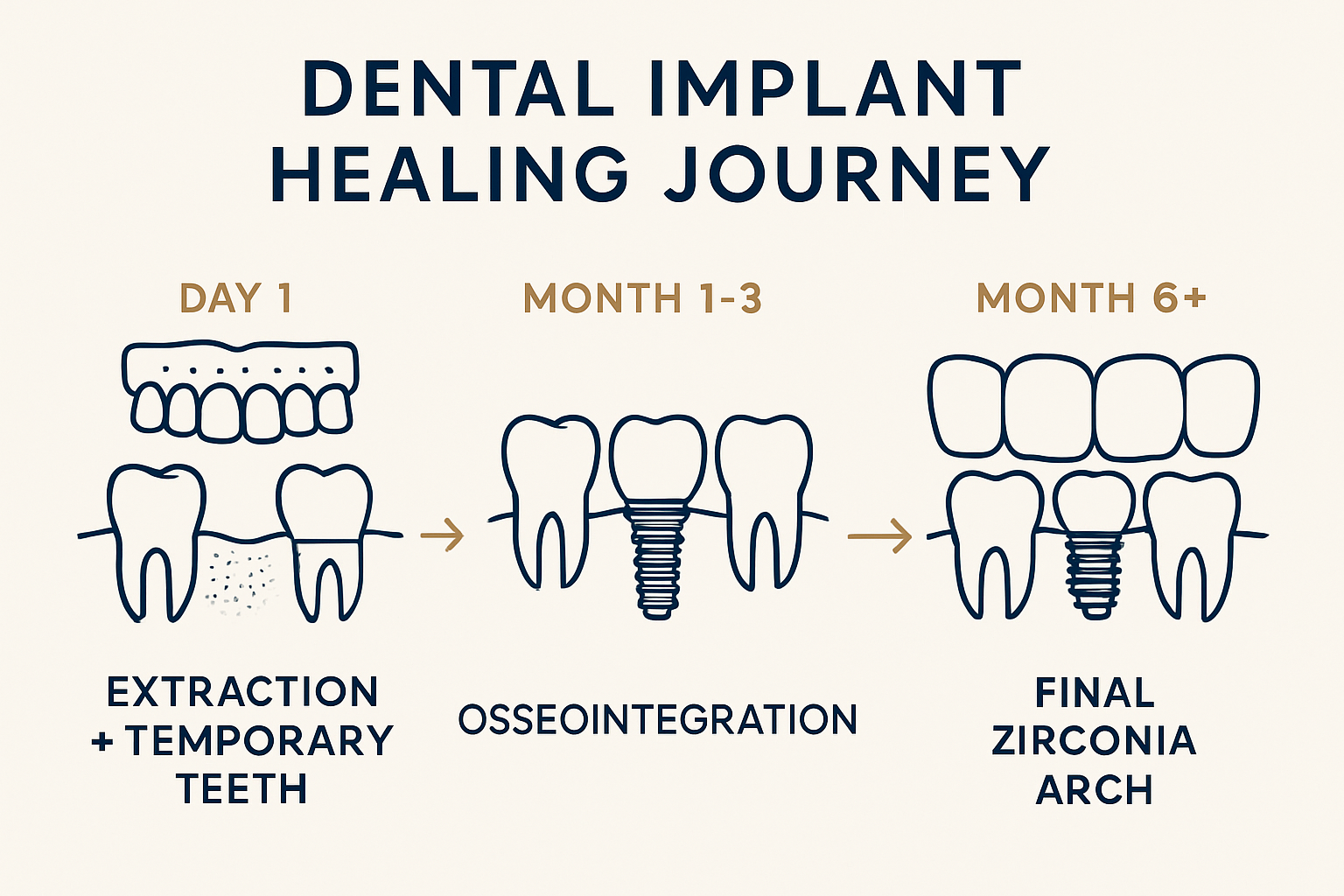
One of the most common sources of confusion for new implant patients is the two-phase restoration process. You don't get your permanent teeth on surgery day, you get a set of temporary teeth first, then your final arch three to six months later. Understanding why this timeline exists, and what each phase actually looks and feels like, makes the whole process far less stressful.
Surgery Day: Extractions, Implants, and Same-Day Temporaries
On the day of your procedure, any remaining failing teeth are removed and the implants are placed in the same appointment. Thanks to our fully digital pre-surgical planning at Noland Implants & Aesthetics in Heber Springs, AR, the case is designed before I ever pick up an instrument. That preparation is what makes same-day temporaries possible.
You leave our office with a full set of temporary teeth attached to your implants. These are functional, you'll be able to speak normally and eat soft foods that same day. They're built from durable resin, not the same material as your finals, which means they're protective and cosmetically appropriate but not indestructible. No hard or crunchy foods while you're healing.
The temporary arch also serves a clinical purpose: it protects the implant sites while healing begins and gives me a preview of your bite, phonetics, and aesthetics before we finalize your permanent restoration.
The Osseointegration Phase: Typically 3–6 Months
Osseointegration is the process where your jawbone fuses directly to the titanium implant surface. This is not optional or acceleratable, it's a biological process that takes typically 3–6 months depending on your bone density, overall health, and how many implants were placed.
During this phase, you'll check in at regular intervals so I can monitor healing, adjust the temporaries if needed, and confirm integration progress. I don't move to final restorations until I'm confident the implants are fully stable. Practices that skip this monitoring or rush to finals before healing is confirmed are taking a shortcut that compromises your long-term result.
Your temporaries stay in and function normally throughout this period. Most patients adapt to them quickly and report comfortable eating and speaking within the first week or two.
Final Arch Delivery: The Permanent Restoration
Once osseointegration is confirmed, we move to your final arch. At Noland Implants & Aesthetics, final restorations are built in our in-house master ceramist lab, not sent to an outside facility. This means direct quality control, faster turnaround, and custom craftsmanship calibrated to your specific anatomy and bite.
The final arch is typically zirconia: exceptionally strong, stain-resistant, and designed to match the appearance of natural teeth. The fit, bite, and aesthetics are refined in the delivery appointment until everything feels right. From there, your implant process is complete.
"The two-phase process exists to protect your investment. Rushing osseointegration doesn't save time, it risks the implants themselves. The temporaries work. Trust the timeline.", Dr. Conner Noland, DDS
Why the Timeline Protects Your Investment
The dental implant healing process in Heber Springs, AR, and anywhere else, follows biology, not marketing schedules. Practices that promise finals in weeks rather than months are skipping critical verification steps. Failed osseointegration means failed implants, which means starting over at significant cost.
My approach is structured but efficient. We use every checkpoint to optimize your outcome. When you receive your final arch, it's because the foundation is ready, and it will hold for decades with proper care.
Call (501) 362-0550 to request your free consultation at Noland Implants & Aesthetics, 821 W Main St, Heber Springs, AR 72543. I'll walk you through the complete timeline for your specific case before you commit to anything.
Ready to Ask the Right Questions?
Dr. Noland walks every patient through the complete timeline before treatment begins. Call (501) 362-0550 to request your consultation.
Call (501) 362-0550