Full Arch Dental Implants in Arkansas: What You're Really Evaluating
If you're looking at full arch dental implants in Arkansas, you're in a fundamentally different category than someone researching a single crown or basic dental work. Full-arch restoration is a surgical, prosthetic, and lab-intensive process that takes typically 3–6 months from start to finish and is meant to last decades. The decisions you make upfront, about your provider, your imaging, your lab, your surgical protocol, determine the quality of the outcome you'll live with.
This guide covers what the procedure actually involves, who it's right for, and what separates a practice worth trusting from one running volume.
What Full Arch Dental Implants Are
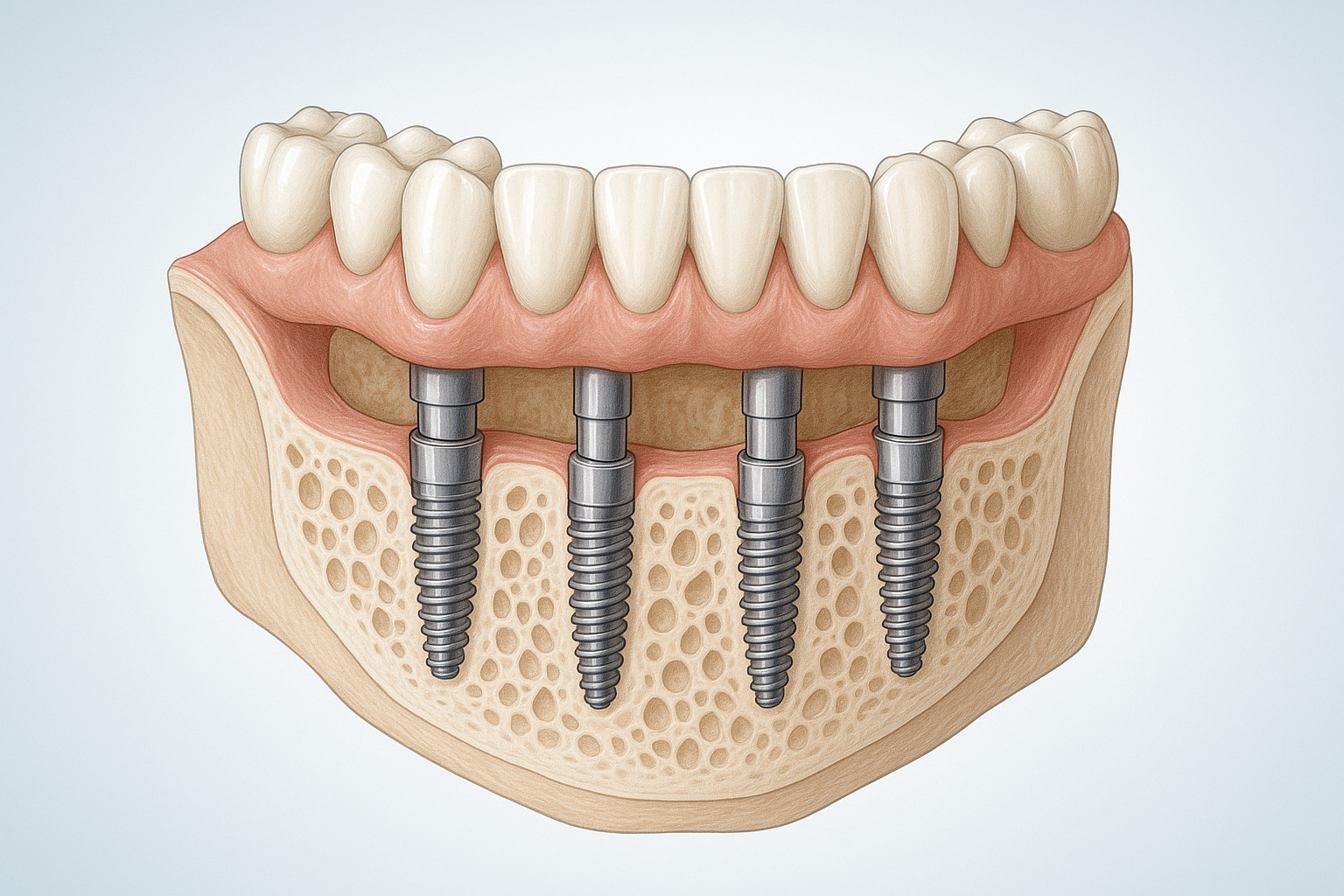
Full arch dental implants, commonly called All-on-X, replace an entire upper or lower arch of teeth using four to six titanium implants anchored in the jawbone. These implants fuse to the bone over typically 3–6 months through osseointegration. Once that bond is established, a permanent prosthetic arch attaches to the implants and functions like a fixed, natural set of teeth.
Unlike traditional dentures, implant-supported arches don't move. They don't require adhesives. They stimulate the jawbone the way natural tooth roots do, preventing the progressive bone loss that makes dentures an increasingly poor fit over time. You eat what you want, speak normally, and maintain oral hygiene with routine brushing and water flossing.
Who Is a Candidate?
Most people who have lost all or most of their teeth, or who have teeth failing from gum disease, decay, or fracture, are candidates. Full arch implants are also well-suited for people who wear dentures but want a stable, fixed alternative.
Patients with severe bone loss are not automatically excluded. Advanced placement techniques, including pterygoid implants anchored in the dense pterygoid plate behind the upper jaw, and zygomatic implants anchored in the cheekbone when the upper jaw has almost no bone left, allow full-arch restoration in many cases where conventional implant placement would fail. If you've been told your bone is insufficient, that opinion is worth a second evaluation before accepting it.
The Full Arch Process: Step by Step
- CBCT evaluation and planning: A 3D cone beam CT scan maps your bone volume, nerve location, sinus proximity, and implant sites before surgery begins.
- Surgical appointment: Failing teeth are extracted and implants are placed in the same visit. Same-day temporaries are attached so you leave with a functional set of teeth.
- Osseointegration monitoring (typically 3–6 months): Regular check-ins confirm that implants are fusing to bone. Temporaries are adjusted as needed for comfort and bite.
- Final arch delivery: Once integration is confirmed, the permanent restoration, typically zirconia, is fabricated and delivered. At Noland Implants & Aesthetics, this is built in our in-house master ceramist lab.
What Makes Noland Implants & Aesthetics Different
Full-arch restoration is the foundation of this practice, not a service we added on. Dr. Conner Noland has focused exclusively on implant surgery since graduating from UTHSC in 2022, and performs 15+ full-arch cases per month at our Heber Springs, AR location. That kind of volume builds clinical judgment that can't be shortcut.
What that volume and focus produces:
- A fully digital surgical workflow: CBCT, photogrammetry, Exocad, every case planned to submillimeter precision before the first instrument is picked up
- An in-house master ceramist lab staffed full-time, no outsourced fabrication, no third-party markups, no communication delays
- Advanced pterygoid and zygomatic implant techniques for patients with severe bone loss who were told elsewhere that implants weren't possible
- 4.9-star Google rating across 273+ patient reviews
- I perform the consultation, the surgery, and the final delivery, you work with one provider who knows your case from start to finish
What to Expect at Your Consultation
Your first appointment at Noland Implants & Aesthetics is a comprehensive clinical evaluation, not a sales presentation. We'll review your CBCT imaging, assess your bone quality, and discuss exactly what we'd recommend for your case, including how many implants, what technique, what timeline, and what your complete all-inclusive cost looks like. You'll leave with a clear picture before making any decisions.
Call (501) 362-0550 to request your free consultation at 821 W Main St, Heber Springs, AR 72543. If you're evaluating full arch dental implants in Arkansas, start here. We'll tell you exactly what your case requires and what to expect.
See If You're a Candidate
Dr. Noland offers complimentary consultations for full-arch patients. No pressure, just answers.
Request a Free Consultation