Patients researching full-arch implants quickly run into three names: All-on-4, All-on-6, and All-on-X. These terms are used interchangeably in a lot of marketing, which creates real confusion. Here's the honest breakdown of what each term means, why the number matters, and what you should actually be asking before you commit to any provider.
In this guide
What the Numbers Mean
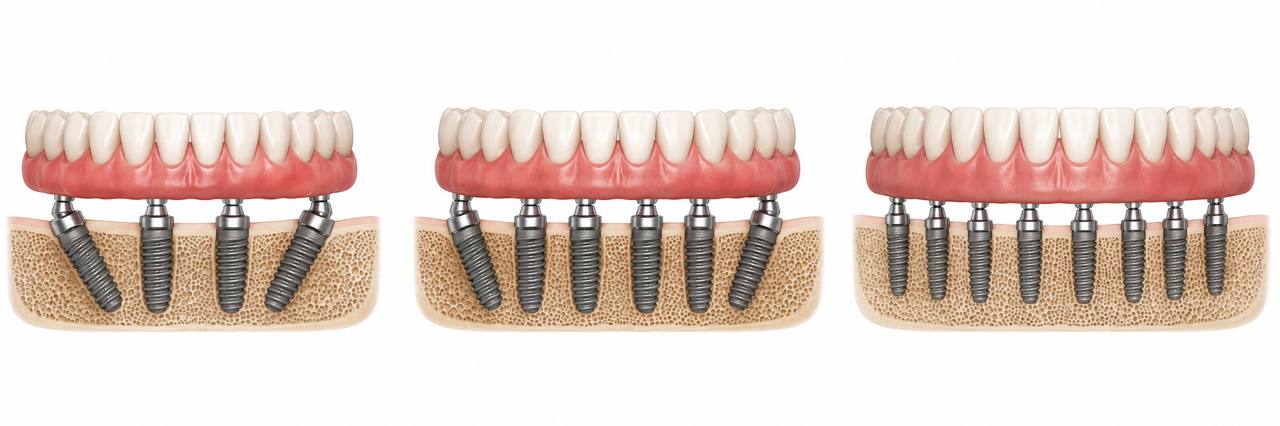
"All-on-4" is a specific protocol developed by Nobel Biocare: four implants per arch, with the two rear implants placed at a 45-degree angle to maximize engagement with available bone. It was designed as an efficient, cost-effective approach, especially for patients with limited posterior bone.
"All-on-6" uses six implants per arch, distributing chewing load across more anchor points. This generally produces better long-term stability, particularly for patients with denser bone or higher bite forces.
"All-on-X" is not a trademarked protocol, the X is intentionally variable. It simply means the number of implants is selected based on your specific bone anatomy, not a predetermined formula. That flexibility is a feature, not a vagueness. It means the plan is built around your jaw, not a marketing number.
At Noland Implants & Aesthetics in Heber Springs, AR, every full-arch case gets evaluated on its own terms. I don't default to four because it's faster. I place the number that gives your case the best long-term outcome.
A patient who was where you are
Back in Pictures, Back at the Table
Done with dentures; we were the office that called back and worked out a payment plan.
Watch the full story (2:26)Placement Matters as Much as Number
The count of implants only tells part of the story. Where they're placed, and how they're angled, determines how well they distribute chewing forces and integrate with your available bone.
Angled (tilted) implants let us work with bone that exists rather than requiring grafts to create bone where it's missing. This keeps surgery less invasive and recovery faster. When posterior bone is severely compromised, pterygoid implants anchor into the dense pterygoid plate at the back of the upper jaw, bypassing the area of bone loss entirely and eliminating the need for sinus grafts in many cases. When the upper jaw has almost no usable bone left at all, zygomatic implants go a step further and anchor into the cheekbone, which stays dense because it never resorbs the way the jaw does after teeth are lost.
Most high-volume practices default to four implants because it's faster and cheaper. My clinical philosophy is different: I place five, six, or more implants per arch whenever bone volume allows, because better load distribution means longer-term stability and reduced risk of implant stress fracture over time. This is a deliberate decision made case by case, not a default setting.
Wondering if this applies to you? A free consultation with a 3D CBCT scan answers it in about an hour, with a written, all-inclusive price and no pressure.
What to Ask Any Provider Before You Commit
Don't let a provider sell you a number without explaining the reasoning. Ask these questions directly:
- How many implants do you plan to place, and why that number for my anatomy?
- Will any implants be angled, and what does that mean for my case?
- Do you use pterygoid or zygomatic implants for severe bone loss, or do you require grafting?
- Who designs the restoration, an in-house lab or an outside lab?
- How many full-arch cases do you complete per month?
These questions separate providers who customize from those who standardize. The answers should be specific to your CBCT scan, not a script.
"The right number of implants isn't four or six, it's the number your jaw needs for a stable outcome. That's what I evaluate on every case.", Dr. Conner Noland, DDS, General Dentistry
The Bottom Line on All-on-4 vs All-on-6 vs All-on-X
All-on-4 is a fine protocol for the right patient. It's not the right protocol for every patient. All-on-6 provides more support and is often the better choice when bone volume allows. All-on-X means the plan is truly individualized.
The mistake patients make is choosing a provider based on the number they advertise rather than the clinical judgment behind it. At Noland Implants & Aesthetics, I have placed hundreds of full arches. That experience, combined with our fully digital workflow (CBCT, photogrammetry, Exocad) and in-house master ceramist lab, means your restoration is built with precision, not guesswork.
Request your free consultation by calling (501) 362-0550 or visiting us at 821 W Main St, Heber Springs, AR 72543. We'll review your imaging and tell you exactly what we'd recommend for your case, and why.